top of page
BAMBOO_edited.jpg
EASTERN BALANCE ORIENTAL MEDICINE FB HEADER.jpg

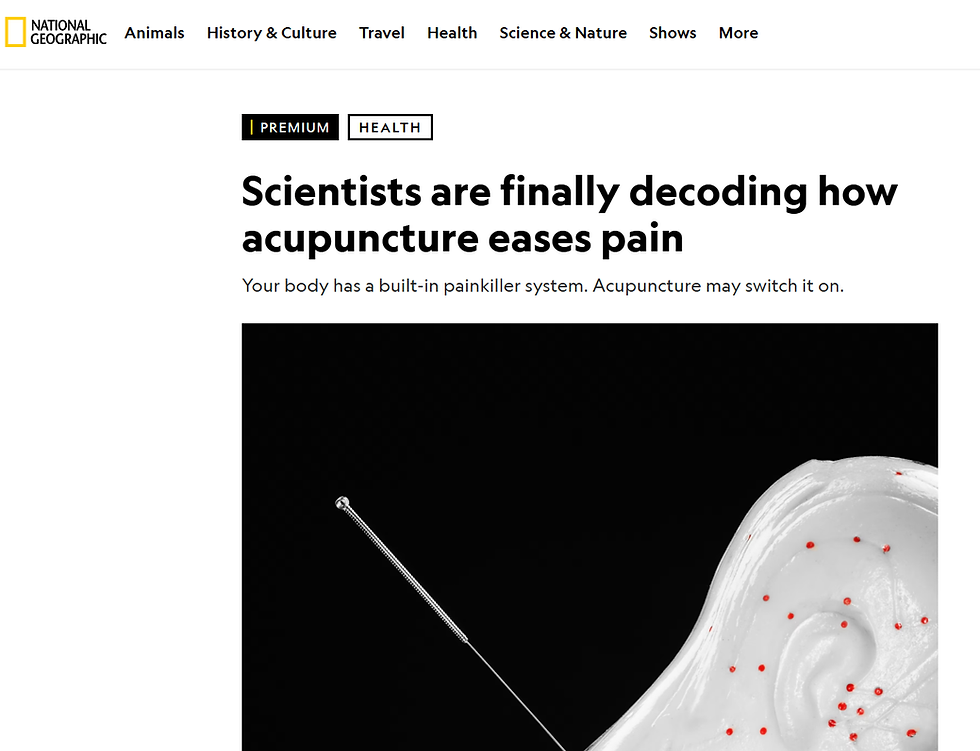
"Scientists are Finally Decoding how Acupuncture Eases Pain:

  • May 7
  • 2 min read

Your body has a built-in painkiller system. Acupuncture may switch it on". 

If you’ve ever wondered whether acupuncture really works—or if it’s just an elaborate placebo—this article offers one of the clearest, most science‑grounded explanations to date. It walks readers through the fascinating new research showing that acupuncture doesn’t just “relax” you; it sparks a cascade of measurable biological events involving connective tissue, immune cells, and the brain’s pain‑processing networks.


What makes the piece especially compelling is how it blends ancient medical theory with cutting‑edge technology. High‑field fMRI scans, soft X‑ray imaging, and ultrasound are now revealing what Traditional Chinese Medicine has described for centuries. Even more intriguing is the first-ever double‑blind acupuncture trial, which finally separates true physiological effects from placebo—and the results strongly favor real acupuncture.


We are excited to share this May 6, 2026, National Geographic article by Daniel Seifert that zooms out to explore the global implications: how acupuncture could help reduce reliance on opioids, why the WHO is pushing for evidence‑based integration of traditional medicine, and how this research could reshape pain care worldwide.


For anyone curious about holistic medicine, neuroscience, or the future of pain treatment, this is a must‑read. It’s accessible, scientifically grounded, and surprisingly hopeful about where integrative healthcare is heading.


Taken from the May 6, 2026, National Geographic Article Scientists are finally decoding how acupuncture eases pain | National Geographic:

Kim Sungchol, unit head for Traditional, Complementary, and Integrative Medicine at the World Health Organization (WHO), is hoping such evolutions (alternatives to how pain is treated globally—offering a low-cost, non-addictive option even as health systems search for alternatives to pharmaceuticals) continue. His team is propelling the WHO’s Global Traditional Medicine Strategy 2025–2034, which aims to integrate evidence-based traditional practices into modern healthcare systems. "According to the most recent WHO global reports on traditional and complementary medicine, acupuncture is now the most extensively used intervention worldwide within this field"' notes Kim.


As the evidence base grows, acupuncture may also serve as a gateway for broader acceptance of other traditional therapies, from herbal medicine to meditation—many of which are now studied with increasing clinical rigor.


The results could be transformative. In the United States, where the opioid crisis has claimed more than a million lives since 2000, non-pharmacological approaches to pain management are gaining renewed attention. Some studies suggest acupuncture may reduce both postoperative pain and the need for opioid medications, though results vary.

“Ultimately, the vision for 2034 is not about promoting one system over another, but about stronger health systems that reflect how people seek care,” says Kim.

Comments


bottom of page